I was introduced to Ahmad Jamal through curiously interconnected events.
In any case, I find that only a handful of pianists play in his phrasings. To demonstrate, I attach two of his compositions from his album The Awakening. I do not know much about this album, nor do I care in the light of this discussion.
One song is I Love Music. This song has a chord progression (or maybe a series of those) that has been sampled (one section of it sliced and looped as the backing progression) in multiple songs over multiple years.
The most famous example would be The World is Yours by Nas (an "East Coast hip-hop" rapper). The song is regarded as one of the greatest hip-hop songs ever produced.
The other song is Dolphin Dance. It does not have a lore as such, but rolls in a similar Ahmed-Jamal style.
Every pianist adds his flavour to any composition he plays -- even if his own. Flavour that resides outside the composition on paper. An interesting way to think of this is that every pianist has kinks in his playing. These kinks are developed --
through ergonomic adjustments: e.g. what kind of embellishments does the pianist find most comfortable to play
through genre adaptations: e.g. what kind of embellishments does he play the most in his homeground genre of music
through imitative knacks: e.g. what kind of embellishments did the musician like the most to hear and would be motivated to imitate.
A mixture of these, unique to every individual, trains the individual in becoming the musician he is.
Let's talk about Ahmad Jamal's phrasings. The extremely intriguing thing about Jamal is that he will take a happy tune and give it a dark, strong, moving vibe so much so that it now has a narrative of its own. Another observation is his compositions are extremely 'rootless'. It is one thing to reharmonise a tune laid in a conventional scalic setting into something polytonal and jazzy, but it is entirely another to destroy the need for static foundation in a song. Instead, the base is shifted to something dynamic, transient and coexisting with other platforms of the song's progression.
Robert Glasper is one pianist that plays in a style that in many ways resembles Jamal.
Even without his accolades and a decorated musical career, Glasper is a brilliant musician -- which is the first and foremost fact that matters. I found the above two performances very similar in spirit to Jamal's playing.
All I'm saying is pronounce what you sing! Or atleast have a mnemonic system! It's awesome.
Let me explain why.
A singer can not
Parts can be effortlessly and efficiently transmitted to another musician without any scope of ambiguity, because every note being played is also being pronounced.
A con is that the sargam system requires a root. It is not an atonal system of nomenclature.
It is also relative in pitch and is based on the root pitch.
Bol and Konnakol are one and the same - they are mnemonics for percussion. Bol is the Northern system of nomenclature whereas Konnakol is the Southern. Konnakol, an intricate part of Southern Classical music, frequently called Carnatic or Kannadic music, has also found great popularity in Western nations.
Have you ever wondered what a guitarist plays on the guitar?
What notes are the strings sounding?
They press on a fret with a certain placement of fingers, which alters the pitch of each string, and strum the strings. trrrang! Something sounds - they call it a chord. It is basically a cluster of notes. It sounds... "harmonious". But what is harmonious? What is harmony?
Harmony is a cluster of notes
If you sound any note and its fifth note simultaneously - for example play C (1) and G (5) - you will instantly feel as if they "go together". You'll also feel deeply nourished and somehow very anchored. Try playing a note and its flat-second together - e.g., C (1) and C# (b2) - wow, that is not pleasant at all. In fact, it is almost repulsive. Again play a note and its natural 3rd note together - e.g., C (1) and E (3) - they sound nice, calm, happy. What about the flat 3rd? C(1) and Eb (b3) when played together give a sense of danger, gloom.
Why is all this happening? Why is any of this happening?
First of all, what do you even call this style of playing that Sylvain Luc has!?
The one holding the natural yellow Godin guitar in the video thumbnail - that's Sylvain Luc. Well, that was Sylvain Luc. Maestro died 13th March, 2024. I'm writing this on July 10th - it's barely 3 months since he passed away - at the very unripe age of 58.
I've been hooked on to whatever extremely-little recorded material - audio, video, both - that he has produced and floats around the internet. He made very limited appearances on "high-profile" jazz festivals. His favourite duet was Bireli Lagrene - a celebrated name in the world of jazz and gypsy jazz guitar (source:Wikipedia).
Before we go any further, I'll be frank here - I'm unqualified to talk in depth about dense/rigorous musical ideas or propositions. I have very little knowledge of and absolutely zero accreditation in music theory, musical philosophy and music history. Still, from the little I have garnered, heard, seen and played, what I am writing is what I have felt and found important to be told.
Of course, I like Luc far, far more than Lagrene. Luc is still fairly unknown, despite being one of the finest improvisors - in both creative imagination and technical proficiency - to ever have existed. I'll talk about this.
His simultaneous dexterity in multiple instruments probably contributed to this musical genius - he was prodigious at the guitar, cello, violin and mandolin. When you're acquainted with multiple instruments, you are versed in instrument-specific varieties of phrasings, tonal and musical ideas. A pianist thinks in a particular way, which happens to be different from, say, a guitarist or a bassist, and still more from a violinist. Such differences pour out the most during improvisations.
Godin Multiac Nylon
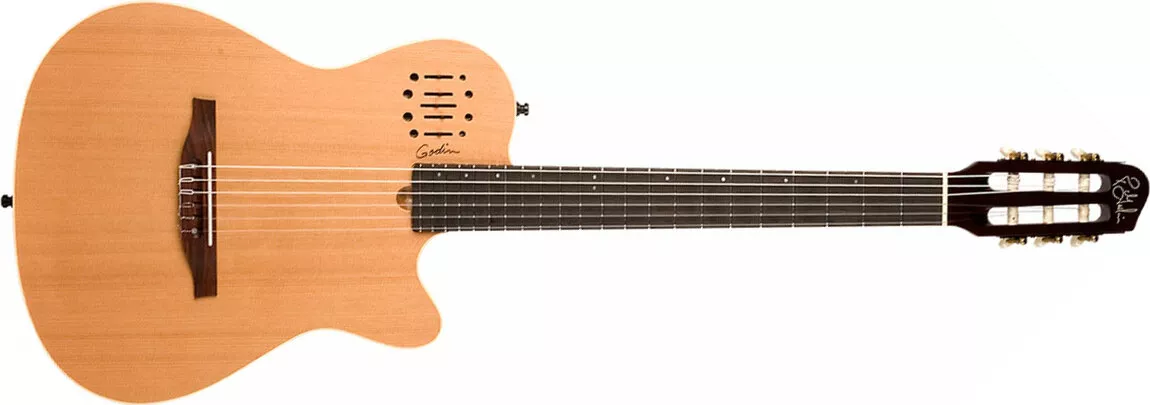
It seems that Luc's favourite guitar was the Godin Multiac Nylon. It's this thing below:
Like I've been hooked onto Sylvain, I've been hooked onto this Godin guitar. It retails for around 2,00,000 INR here in India - which is a huge deal. It is 10 times a person's average salary. Not a dispensable amount of savings will go into it, if it does.
The amazing thing about this guitar however is that (as the lores suggest!) 6 separate pickups - one for each string! Now that is genius - that gives you the capacity to fine tune the acoustic shape of each and every string - which is bound to be fairly different as factors like the radius, winding, etc. change, starting from the thickest low E bass string, to the thinnest high E string. Other guitars do not go this length - they settle the deal with a single piezo strip running below the bridge that pick up vibrations from all strings all at once.
There's also something called Digital Acoustic Modelling which this guitar can do; basically meaning that it can simulate the sound of an acoustic hollow concert-bodied classical guitar digitally, from the string sounds. It can also send MIDI output. But I think these are flashy upgrades that genuine artists will not find much use for - out of the apprehension that such advanced playing aids will signify their handicap in natural playing.
The sound of the Godin is unbelievably round. It is very weirdly sinusoidal and yet a tiny - very tiny - bit squeaky. It has a gorgeous choppy attack. It is like a tone ornamented with divine flaws. When it rings, you feel like somebody grabbed you with a gentle jerk and kissed you softly, prolongedly, on your forehead.
I hope you don't think Godin has sponsored any of these compliments; on a separate note, if they did, however, sponsor me a guitar, that would be nice. Beyond 'nice' actually - insane.
Godin and Neo Gypsy Jazz - a perfect marriage
Watch this - Sylvain Luc & Bireli Lagrene playing Stella by Starlight. You won't get a feel of what I'm saying without having a listen to something of Sylvain Luc. Sylvain plays immaculately - the ideas that flow out of his hands spontaneously are one-of-a-kind. I'll talk with reference to that video because I like it so much.
Here's the thing about Gypsy jazz: it is traditional. Gypsy jazz has its signature chord shapes and changes, strumming patterns, melodic movements and embellishments that make it what it is. And part of that package is the choice of instruments. Generally the scheme is acoustic (particularly Gypsy jazz D-hole) guitar and upright basses. Here is the first deviation. The standup here is:
Hollow body electric guitar
Semi-acoustic nylon string guitar
Upright bass
Stella by Starlight is no doubt a pure jazz number, but the playing artists are Gypsy jazz musicians. You'll see that abundantly in the runs they play, their occasional note bends and embellishments and the comping.
The more you keep listening, you realize that it is a perfect marriage between the tone of Luc's guitar and the style of his playing - neither of them too abrasive, nor too slippery. Emotive, playful, ambiguous and abstract, yet bearing the essence of Gypsy jazz at its core.
Bireli is an excellent proponent of the Manouche style - he is rigorous for that matter; so much so that he is a staple in Gypsy jazz musical content. Sylvain is a detached soul, a guest who graces at will. He has stood at the juncture of musical territories and broken fences, smuggled ideas across. Certain melodies I've found him playing have left me frozen - for one, I never thought such melodic movements could convey an emotion - and for another, once you hear them, there is nothing else you can hear that feels more appropriate in that context.
Sylvain was beautiful. It is perhaps a fallacy that beautiful souls could contribute even greater magnificence to the repositories of human inquisition had they survived longer - a fallacy we strongly associate with figures of arts and science who died young. Sometimes, geniuses die because they have poured all ingenuity out of themselves - their work here is done. That can be the only consolation to Sylvain's departure - that his work here was, hopefully, done.